Private executive rehab in Spain for professionals facing burnout, problematic alcohol use or both – with highly personalised support in our small, discreet setting.
Why executives and professionals can be particularly vulnerable to burnout
Burnout rarely develops because of one difficult week or a single stressful project. For executives, business owners and professionals in positions of responsibility, it is often the result of prolonged pressure combined with too little genuine recovery.
Senior roles can create a particular kind of strain. Executives are expected to make decisions, solve problems, motivate others and remain reliable even when they themselves are under considerable pressure. At the same time, they may have fewer opportunities than other employees to admit uncertainty, exhaustion or emotional overload.
Over months or years, this combination can gradually exhaust physical and psychological resources.
High levels of responsibility and constant decision-making
Executives carry responsibility not only for their own work, but often for employees, budgets, strategic decisions and the future of an organisation.
Important decisions may have financial consequences, affect jobs or determine whether a project succeeds or fails. Even when responsibilities are formally shared, senior managers frequently feel that difficult situations ultimately end up on their desk.
This continuous decision-making can become mentally exhausting. There is rarely a point at which everything is finished. One problem is solved and another immediately takes its place.
For some executives, this creates a permanent state of alertness in which the mind remains focused on work even outside normal working hours.
When being available becomes the normal state
Modern communication makes it increasingly difficult to create clear boundaries between professional and private life.
Emails, messaging apps, video calls and smartphones make it possible to remain available almost everywhere. For people in senior positions, this can quickly turn from a convenience into an expectation.
The working day may technically end, but mentally it continues. A message from an important client, a problem within the team or an unexpected development may immediately bring work back into the evening, the weekend or even a holiday.
As a result, periods that should provide genuine recovery are repeatedly interrupted. The body may be at home or on holiday, while the mind is still dealing with work.
Over time, this lack of mental distance can contribute significantly to exhaustion.
Pressure from different directions
Executives frequently occupy an uncomfortable position between different groups with different expectations.
Senior management or shareholders may demand higher performance, better results or cost reductions. Employees, on the other hand, may expect support, understanding, stability and protection from excessive demands.
The executive has to manage both sides. This can create situations in which there is no solution that satisfies everyone. Difficult decisions may have to be made even when the person making them would personally prefer a different outcome.
Living continuously with competing expectations can become an important source of psychological stress.
The emotional demands of leadership
Leadership is not purely about strategy, figures and organisational structures.
Managers also have to deal with people.
They may need to conduct difficult performance reviews, resolve conflicts, deal with disappointed employees, communicate unpopular decisions or even dismiss members of staff.
At the same time, they are often expected to remain calm, professional and emotionally stable.
This requires considerable emotional self-control. A manager may be dealing with serious personal stress while still being expected to motivate a team, chair a meeting and project confidence.
When this becomes a permanent pattern, there may be very little space left to process one’s own emotions.
Isolation at senior level
The higher someone moves within an organisation, the more difficult open conversations can sometimes become.
An executive may have many colleagues and employees around them but still have very few people with whom they can speak completely honestly.
Some problems cannot easily be discussed with employees because doing so might undermine confidence. Other concerns may be difficult to raise with senior management because the executive fears appearing weak, overwhelmed or unsuitable for the role.
Business owners and managing directors can experience this even more strongly because there may simply be no higher level within the organisation to turn to.
This form of professional isolation can make stress considerably harder to manage.
Instead of discussing problems early, many executives continue functioning until the pressure becomes much more serious.
High standards and perfectionism
Many successful professionals have qualities that helped them reach their position in the first place: ambition, discipline, reliability and a strong sense of responsibility.
These characteristics can be valuable professionally, but they can also become problematic when there are no limits.
A person who has always solved problems through greater effort may respond to increasing exhaustion in exactly the same way: by working even harder.
Warning signs are ignored. Breaks are postponed. Holidays become working holidays.
Some executives also find it difficult to accept that their own performance has limits. Asking for help may feel incompatible with the image they have of themselves as someone who manages difficult situations.
This can allow burnout to develop for a long time before it is openly acknowledged.
Signs of burnout in executives and professionals
Burnout does not normally appear overnight. It often develops gradually, which is one reason it can remain unnoticed or be dismissed for a long period.
Executives in particular may become skilled at hiding their difficulties from colleagues and employees. They continue attending meetings, answering emails and making decisions even though their physical and psychological condition is steadily deteriorating.
The warning signs can appear in several different areas.
Persistent physical and mental exhaustion
One of the most common signs is a level of tiredness that normal rest no longer seems to resolve.
Someone may sleep for several hours and still wake feeling exhausted. Tasks that were once routine begin to require disproportionate effort.
Concentration can become more difficult, and even minor decisions may feel mentally demanding. People often describe the feeling that their internal reserves are simply empty.
Difficulty sleeping and switching off
Sleep problems are particularly common when the mind remains in work mode long after the working day has ended.
Some people struggle to fall asleep because they continue reviewing conversations, decisions or unresolved problems.
Others wake during the night and immediately begin thinking about work.
Even when they sleep for a reasonable number of hours, the sleep may no longer feel restorative. This can create a self-reinforcing cycle: poor sleep reduces resilience during the day, while greater stress makes it even harder to sleep the following night.
Physical symptoms
Prolonged stress can also be accompanied by physical complaints. These may include recurring headaches, muscular tension, digestive problems, palpitations or a general feeling of physical unrest.
Such symptoms should of course always be medically assessed rather than automatically attributed to stress. However, executives experiencing burnout may initially treat individual symptoms without recognising the broader pattern of chronic overload behind them.
Irritability and reduced patience
A change in behaviour can be one of the first signs noticed by colleagues or family members.
Someone who previously handled difficult situations calmly may become increasingly impatient or irritable.
Small problems begin to trigger disproportionate frustration. Questions from employees that once seemed routine suddenly feel exhausting.
This change is not necessarily a sign of poor character or leadership. It can indicate that the person’s capacity to absorb additional stress has become severely reduced.
Changes in leadership style
Burnout can also affect the way a person manages others. Some executives become increasingly controlling. When they feel that their environment is becoming unmanageable, they may try to compensate by checking more details, delegating less and becoming involved in decisions that they would previously have left to others.
Others react in the opposite way and begin withdrawing. They may avoid conversations, reduce contact with colleagues or emotionally distance themselves from the team because they no longer have the energy to engage.
Both patterns can place additional strain on the workplace and further increase the executive’s sense that everything is going wrong.
Difficulty making decisions
Decision-making can also change under prolonged exhaustion. Some people begin making decisions too quickly simply because they want the issue off their desk. Others postpone decisions repeatedly because they no longer feel able to assess complex situations clearly.
The problem is not necessarily a lack of professional knowledge. Mental exhaustion can make it much harder to process information, weigh alternatives and tolerate uncertainty.
For people whose professional identity is strongly connected with being decisive and competent, noticing this change can be particularly unsettling.
Loss of motivation and emotional distance
Another warning sign is a gradual loss of interest in work that was once meaningful.
Achievements may no longer create satisfaction. Success feels empty or merely produces temporary relief before the next problem appears.
Some people become emotionally detached from colleagues or increasingly cynical about their work.
The person may still be functioning externally while internally feeling disconnected from everything they are doing.
Withdrawal from other people
As exhaustion increases, social contact may begin to feel like another demand.
Executives may reduce contact with colleagues outside essential meetings and also withdraw from friends or family.
Even enjoyable activities can begin to feel like obligations. This withdrawal can make the situation worse because precisely those relationships that might provide emotional support are gradually lost.
Continuing to perform while denying the problem
One of the difficulties with burnout among high-performing professionals is that outward functioning can continue for a surprisingly long time.
Someone may still arrive at work every morning, lead meetings and respond to clients while privately sleeping badly, drinking more than before and feeling increasingly unable to cope.
Maintaining the appearance of control can become part of the problem.
The longer the person feels that they must continue proving that everything is under control, the harder it may become to admit that something needs to change.

The connection between burnout and alcohol use
Burnout and problematic alcohol use are separate issues, and not everyone experiencing burnout develops a drinking problem.
Nevertheless, there is an important connection that deserves particular attention among people living under prolonged professional pressure.
Alcohol can gradually become part of the way someone tries to manage stress.
Alcohol as a way to switch off
After a day of continuous pressure, some executives find it difficult to move directly from high alert into relaxation.
A glass of wine or beer in the evening can appear to provide a quick solution.
Alcohol may temporarily create the feeling that the mind has slowed down. Problems seem more distant and physical tension may initially decrease.
For someone who otherwise struggles to stop thinking about work, this effect can become attractive. What begins as an occasional drink after a particularly stressful day can slowly develop into a routine.
The drink is no longer simply enjoyed; it begins to serve a function. It becomes the method used to create distance from work, reduce tension or prepare for sleep.
A cycle that can intensify exhaustion
The difficulty is that the short-term relaxing effect of alcohol does not necessarily produce genuine recovery.
Alcohol can interfere with sleep quality, particularly when larger amounts are consumed regularly. A person may fall asleep more quickly but wake less rested.
The following day, fatigue, irritability and reduced concentration may therefore be greater.
That creates an unfortunate cycle.
Stress leads to alcohol in order to relax. Alcohol contributes to poorer recovery. Reduced recovery makes the following working day more difficult, which creates more stress and strengthens the desire to drink again in the evening.
The original attempt to cope with burnout can therefore gradually become an additional problem.
When occasional drinking becomes a coping strategy
The important question is not only how much someone drinks, but also what role alcohol has begun to play.
If alcohol is increasingly used to calm down, sleep, manage anxiety, reward oneself after difficult days or avoid uncomfortable thoughts, drinking behaviour may be changing even before the person recognises it as a problem.
Because this process can develop gradually, it is easy to rationalise.
A demanding job provides a ready explanation: I have earned this drink. I need it to relax. Everyone in my position does the same.
Over time, however, tolerance can increase and drinking may become more frequent or less controlled.
Burnout and alcohol problems can reinforce each other
Once both problems are present, they can become difficult to separate.
Professional stress and exhaustion may encourage drinking. At the same time, increasing alcohol consumption can contribute to sleep problems, mood changes, reduced concentration and physical exhaustion.
The symptoms can then overlap.
A person may no longer know whether they feel exhausted because of work, because of alcohol, because of poor sleep or because all three factors are interacting.
This is one reason why simply treating one part of the problem may not always be sufficient.
Not every executive with burnout has an alcohol problem
It is important not to suggest that burnout automatically leads to addiction.
Many people experience severe professional exhaustion without developing problematic alcohol use.
Equally, alcohol dependence can develop without burnout.
However, when alcohol has increasingly become a tool for dealing with pressure, insomnia or emotional exhaustion, both issues should be considered together.
Recognising this connection can be an important first step towards changing it.

Why Vida Libre is particularly suitable for executives and professionals
For executives, business owners and other professionals, recovery often requires more than simply taking time off work. The same qualities that may have contributed to professional success – a strong sense of responsibility, high personal standards, constant availability and the ability to keep functioning under pressure – can also make it difficult to recognise when help is needed.
Vida Libre offers a setting in which these patterns can be interrupted. Away from the workplace, daily responsibilities and the expectations of colleagues, employees or business partners, guests have the opportunity to step out of their usual role for a while. There is no team to lead, no company to manage and no need to maintain an image of permanent control.
A small and highly personal setting
Vida Libre is deliberately very small. We usually work with only three guests at a time, with a maximum of four. This makes a very different kind of support possible from that found in large treatment centres.
The programme can be adapted closely to the individual situation of each guest. Intensive one-to-one coaching provides room to discuss subjects that may be difficult to address openly in a professional environment: excessive responsibility, fear of failure, conflicts at work, perfectionism, loss of motivation, exhaustion, private pressures or increasing reliance on alcohol.
For executives who are accustomed to solving problems rather than talking about them, this individual approach can be particularly important.
A confidential space outside the professional environment
Senior positions can be isolating. Executives may hesitate to speak openly about exhaustion, emotional difficulties or problematic alcohol use because they are concerned about their reputation, their position or the consequences for their company.
Vida Libre provides a private environment away from the guest’s normal professional and social surroundings. Mallorca creates a physical and psychological distance from everyday routines without requiring complete isolation from the outside world.
This distance can make it easier to look at one’s situation from a different perspective and to address problems that may have been ignored for months or even years.
Addressing burnout and alcohol problems together
At Vida Libre, the question is not simply whether burnout or alcohol came first. When both are present, they can be addressed as interconnected parts of the same situation. Psychological work can focus on drinking behaviour as well as the occupational pressure, habits and thought patterns that may have contributed to it.
Where alcohol withdrawal or other medical issues need to be considered, medical support can be included according to the individual circumstances and after appropriate assessment.
Time to develop healthier patterns
The aim is not simply to recover enough energy to return to exactly the same lifestyle that caused the problem.
A stay at Vida Libre can also provide an opportunity to examine how work, responsibility, recovery, relationships and personal needs can be organised differently in the future. This may include recognising warning signs earlier, setting clearer boundaries, changing unrealistic expectations and developing healthier ways of dealing with pressure.
For professionals who have spent years functioning at a very high level, learning to protect their own physical and psychological resources can be just as important as solving the immediate crisis.
Professional support without the atmosphere of a large clinic
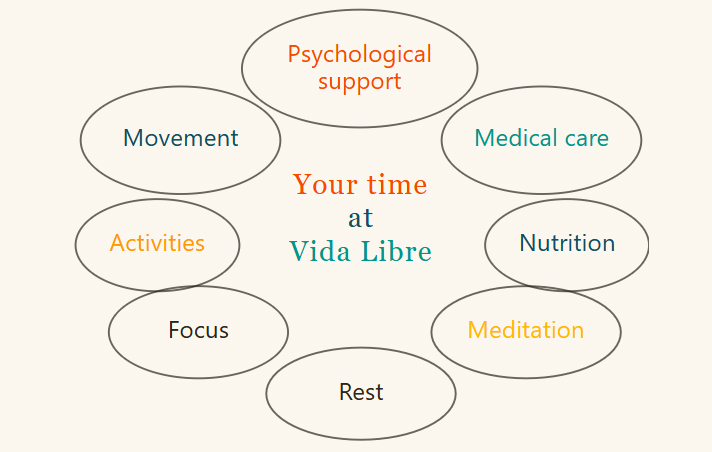
Many executives who seek help do not necessarily identify with the idea of entering a large rehabilitation institution. Vida Libre offers a more personal alternative: intensive psychological support, medical involvement where required, accommodation on the finca and complementary activities within a small residential setting.
The result is an environment that combines professional support with privacy, personal attention and enough distance from everyday life to make meaningful change possible.